


Financial data APIs provide a direct, programmatic pathway to market information. They support a wide range of applications, including financial analytics, research workflows, automated reporting, and data-driven products. In 2026, the ecosystem is mature and competitive. Many providers offer overlapping capabilities on the surface, yet practical differences can affect implementation quality and long-term maintainability.
In practice, providers vary in their market presence and the continuity of their historical datasets. They also differ in the depth and standardization of basic data, the availability of real-time or streaming access, and the limitations imposed by rate limits. The quality of documentation, integration tools, and licensing terms also influences whether an API remains usable after initial testing. Given these differences, we need to determine which Financial data APIs best fit our needs.
In this article, we will review the best financial data APIs available in 2026. The objective is to present clear trade-offs rather than a single universal solution. For each provider, I summarize the types of data you can retrieve, the key advantages and disadvantages, and the contexts in which the API is appropriate.
Curious about it? Let’s get into it.
Financial Modeling Prep (FMP)
Overview
Financial Modeling Prep (FMP) is a financial data API provider that focuses on broad market coverage and practical endpoints for application development. It offers market prices and fundamental datasets through a straightforward REST interface.
Advantages
All-in-one coverage: Provides pricing data, company fundamentals, macroeconomic indicators, and market news in one place.
Rich endpoint selection: Includes many ready-to-use endpoints, reducing the need for additional data stitching.
Strong developer usability: Clear documentation and a predictable API structure make integration and iteration efficient.
Product-oriented fit: Well-suited for building stock screeners, analytics dashboards, and research pipelines that combine price and fundamental data.
Disadvantages
Limited free tier: The free plan is suitable for testing and light usage, but rate limits and reduced data depth limit its usefulness.
Advanced access requires upgrades: Certain datasets and higher-capacity usage are reserved for higher-paid tiers.
Best for
Teams or individuals who want a single API that can support both market data and fundamentals for analysis and product development.
Ideal starting plan
Start with the free tier to validate endpoints and data fit, then move to the entry-level paid tier once you need consistent throughput or deeper coverage.
Alpha Vantage
Overview
Alpha Vantage is a comprehensive financial data API platform designed for both retail investors and institutional trading systems. It provides extensive coverage across equities, options, forex, cryptocurrencies, and macroeconomic datasets, combining real-time market feeds with deep historical data and built-in analytics.
A key differentiator is that Alpha Vantage sources data from licensed exchanges such as NASDAQ and Options Price Reporting Authority (OPRA), enabling access to professional-grade market data infrastructure through a simple API interface. With millisecond-level real-time updates and more than 20 years of historical price and fundamental data, the platform supports everything from educational projects to institutional-scale algorithmic trading systems.
Advantages
Institutional-grade data licensing: Alpha Vantage is officially licensed by major market data authorities, including NASDAQ and OPRA, ensuring reliable and compliant access to equity and options data streams. This makes it suitable for professional trading environments that require high-quality exchange-sourced data.
Real-time and low-latency market data
The platform delivers millisecond-level real-time data, enabling use cases such as algorithmic trading, quantitative research, and automated portfolio monitoring where latency and accuracy are critical.Extensive historical coverage
Alpha Vantage offers 20+ years of historical price data across global markets, along with long-range fundamental datasets. This depth allows analysts and quantitative researchers to perform robust backtesting and long-horizon market studies.Built-in technical analysis library
The API includes a large catalogue of technical indicators that can be retrieved directly through API calls. This significantly reduces engineering overhead for traders and developers who would otherwise need to implement indicator calculations themselves.Accessible architecture for all users
Despite its institutional capabilities, Alpha Vantage maintains a clean, developer-friendly API structure that allows beginners, independent traders, and large trading firms to integrate financial data pipelines quickly.
Disadvantages
Free tier constraints: similar to other providers, certain features are not included in the free tier of Alpha Vantage for compliance and anti-bot purposes.
Best for
Alpha Vantage is particularly well-suited for:
Retail investors and independent developers building trading tools or investment dashboards
Quantitative researchers requiring long historical datasets for backtesting
Algorithmic and institutional trading systems that need real-time exchange-licensed data feeds
Fintech platforms seeking a single API for market data, fundamentals, and analytics
EOD Historical Data (EODHD)
Overview
EOD Historical Data (EODHD) is a market data provider known for broad international exchange coverage and long historical time series. It combines end-of-day and intraday pricing with fundamentals and several optional datasets that support more advanced workflows.
Advantages
Strong global coverage with a long history: Offers broad exchange support and historical depth suitable for long-horizon analysis and backtesting.
High value on paid tiers: Paid plans are competitively priced for the amount of data provided, especially when you need global markets and deeper history.
Solid fundamentals and add-ons: Includes company fundamentals and supports additional datasets such as options and macroeconomic indicators, depending on the plan.
Practical integration options: Supports bulk-style access for efficient retrieval, provides some streaming capabilities, and offers spreadsheet-friendly integrations for Excel and Google Sheets.
Disadvantages
The free tier is primarily for evaluation. Request limits are restrictive, so it is best treated as a connectivity and fit check rather than a long-term solution.
Real-time depth is uneven: Real-time availability and latency can differ by asset class and region, with stronger coverage typically in U.S. markets than in many international markets.
Best for
Projects that require global market coverage and long historical datasets, especially when you want substantial value from paid plans.
Finnhub
Overview
Finnhub is a financial data API that combines market quotes with news and event-oriented datasets. It is widely used for prototyping and product development because it offers accessible pricing and a relatively broad feature set.
Advantages
Generous free-tier limits: The free plan typically provides sufficient request capacity to support meaningful experimentation and early-stage prototypes.
Balanced dataset mix: Provides a practical combination of quotes, news, sentiment signals, and market calendars, helping build context-aware applications.
WebSocket support: Provides streaming access through WebSockets, enabling lower-latency updates without relying exclusively on polling.
Disadvantages
Shallower fundamentals: Fundamental coverage is generally less comprehensive than that of providers that focus heavily on financial statements and deep company datasets.
Paid plans for full access: Longer historical depth and specific premium endpoints are gated behind paid tiers, particularly for more advanced or higher-volume use cases.
Best for
Rapid prototyping and application development that benefits from combining price data with news, sentiment, and event calendars.
Tiingo
Overview
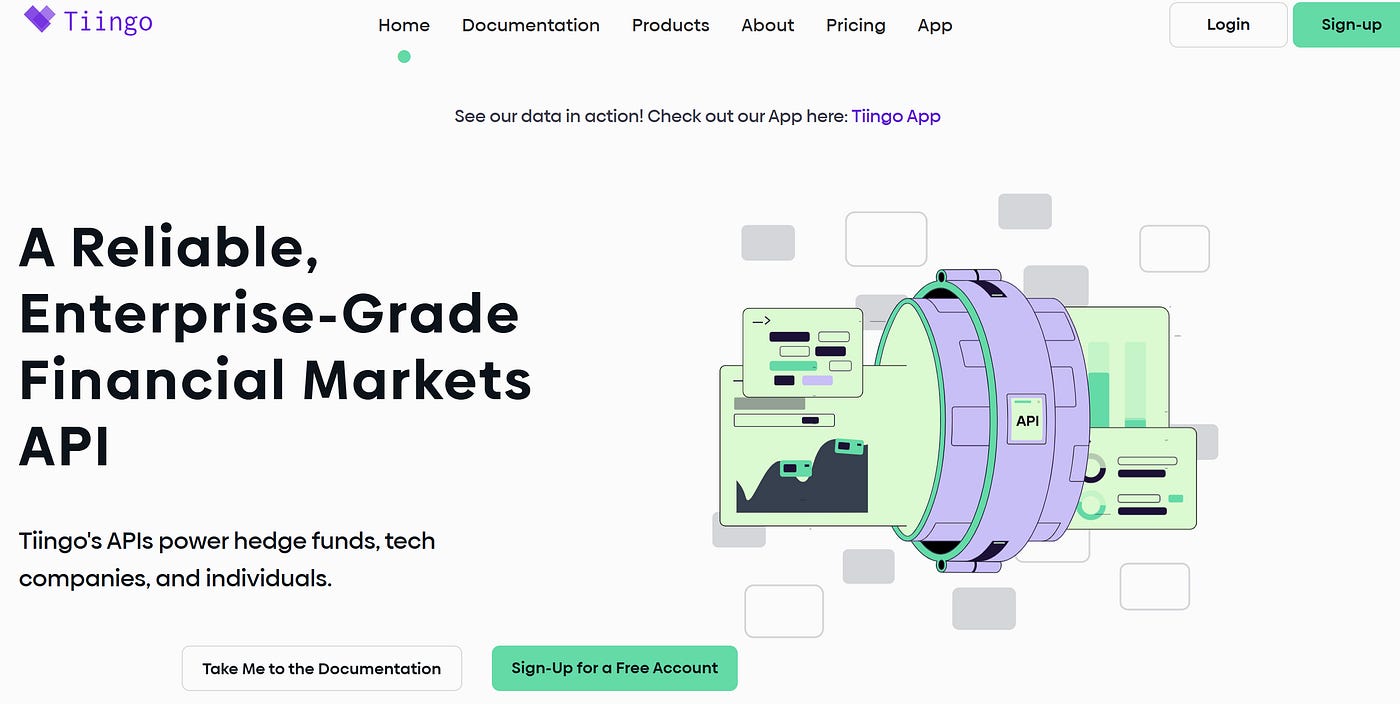
Tiingo is a financial data provider that emphasizes clean historical market data and straightforward API access. It is commonly used in research and backtesting workflows, particularly by individual developers and small teams.
Advantages
Substantial value for individuals: Paid plans are typically affordable given the included data and request limits, making Tiingo attractive to solo builders.
High-quality historical end-of-day data: Tiingo is well-regarded for stable, consistent EOD datasets that support backtesting and long-horizon analysis.
Practical fundamentals for U.S. equities: On paid tiers, Tiingo provides solid fundamental coverage of U.S. companies, often sufficient for screening and basic factor research.
Disadvantages
Less comprehensive as an all-in-one source: Tiingo is not primarily positioned as a single provider of macroeconomic data and commodities coverage so that you may need supplementary sources depending on your requirements.
Real-time and intraday are not the core focus: While intraday data may be available, it is not as central or as feature-complete as providers optimized for streaming or high-frequency use cases.
Best for
Individuals and small teams who want reliable historical market data for analysis and backtesting, with reasonable U.S. fundamentals on a cost-effective paid plan.
Twelve Data
Overview
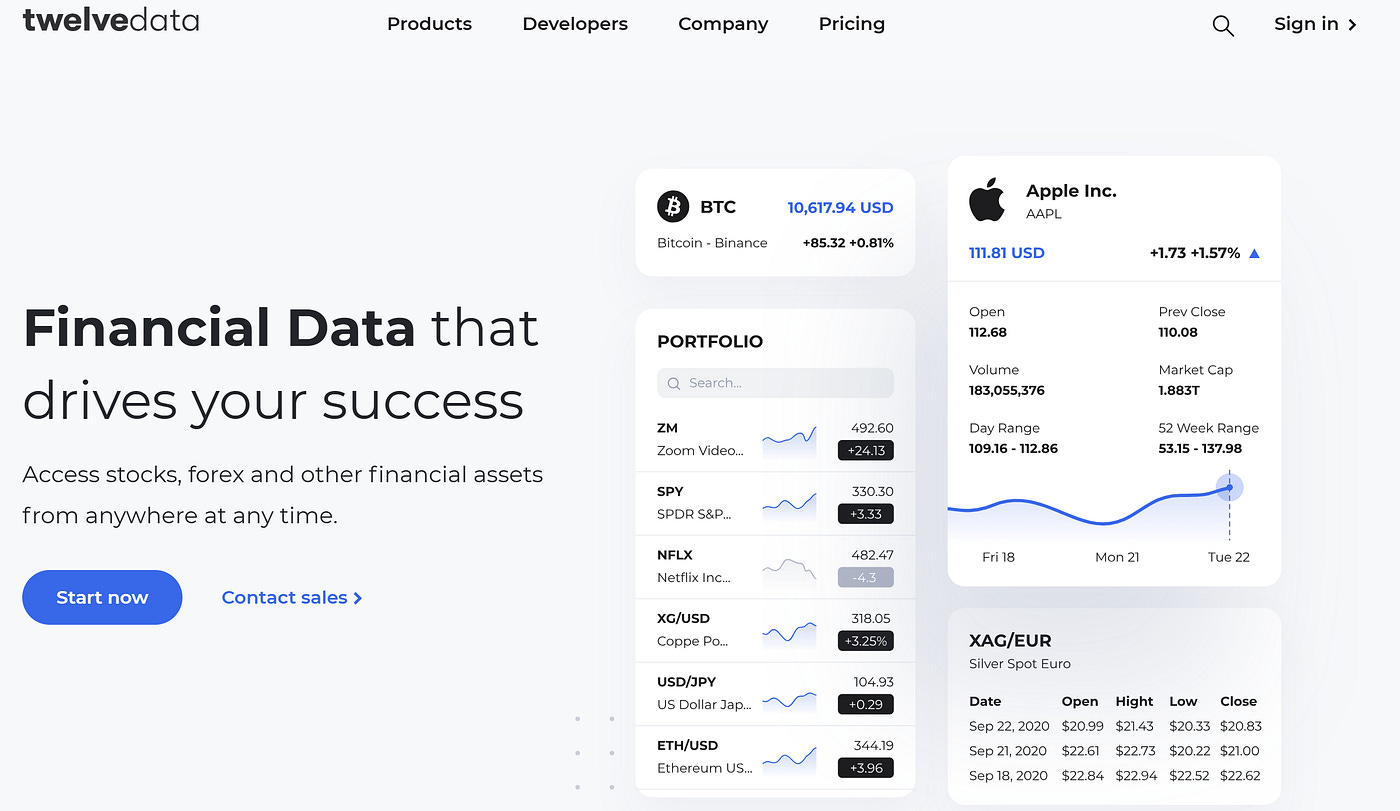
Twelve Data is a market data API focused on time-series access across multiple asset classes. It is commonly used for applications that need consistent pricing endpoints for stocks, foreign exchange, and cryptocurrencies.
Advantages
Clean multi-asset time-series API: Provides a uniform way to retrieve historical and intraday price data across stocks, FX, and crypto, simplifying implementation.
Strong developer experience: Documentation is generally clear, integration is straightforward, and common workflows are well-supported.
Built-in indicators: Includes technical indicators that reduce the effort required to add analytics to a prototype or dashboard.
Disadvantages
Paid tiers may feel expensive: Pricing can be less attractive when compared with alternatives that offer broader datasets at similar cost levels.
Limited depth beyond prices: Fundamental coverage and macroeconomic datasets are typically less extensive than those from all-in-one providers.
Best for
Projects that primarily require reliable multi-asset price time series, a developer-friendly API, and convenient technical indicators.
Marketstack
Overview
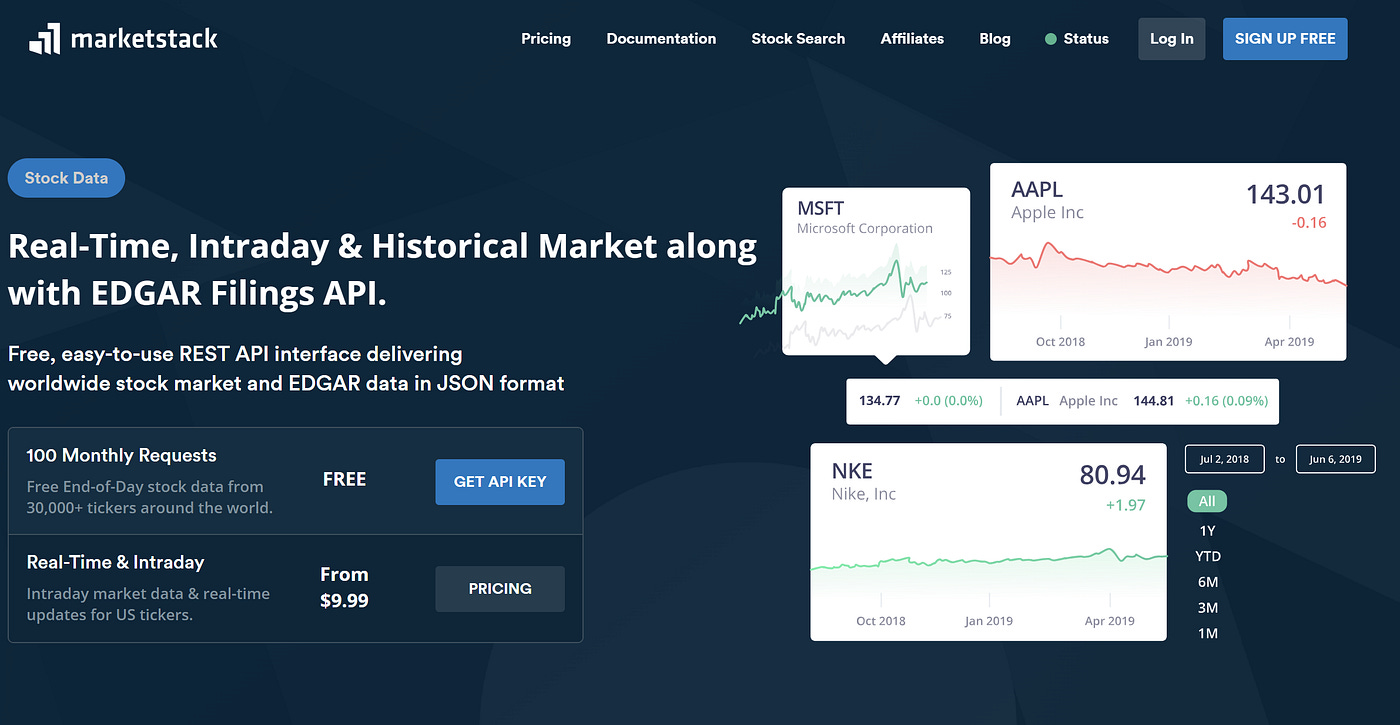
Marketstack is a market data API focused on global equity pricing, with coverage across many stock exchanges. It is designed for simple, real-time, and historical stock price retrieval via a lightweight REST interface.
Advantages
Simple global stock pricing access: Works well when your primary need is equity quotes and historical prices across multiple markets, without complex endpoint structures.
Affordable entry-level paid tier: Paid plans are typically priced for basic application use cases, making them practical for small dashboards and lightweight integrations.
Disadvantages
Limited fundamentals and extended datasets: Marketstack is primarily price-oriented and offers fewer fundamentals, corporate datasets, and value-added endpoints than all-in-one providers.
No integrated FX or crypto coverage: Foreign exchange and cryptocurrency data are not included in the core product and often require separate services.
Best for
Basic applications that need straightforward global stock price data at a predictable cost, without strong requirements for fundamentals or multi-asset coverage.
Polygon.io (Massive)
Overview
Polygon.io (now positioned under the “Massive” brand) is a market data provider focused on high-performance access to U.S. market data. It is best known for low-latency delivery, streaming support, and granular datasets suitable for trading-oriented workloads.
Advantages
Strong U.S. real-time and high-frequency coverage: Well-suited for use cases that require timely quotes and detailed market activity in U.S. equities.
High performance and streaming: Provides WebSocket streaming and fast REST endpoints, which support responsive applications and real-time monitoring.
Granular historical depth: With the appropriate plan, it offers tick-level history and detailed aggregates that are valuable for advanced backtesting and microstructure analysis.
Disadvantages
U.S.-first scope: Coverage is primarily U.S.-focused, making it not the best fit for projects requiring broad global exchange coverage.
Cost scales quickly for premium access: Real-time entitlements and extensive historical depth are typically available only on higher-priced tiers, which can be more expensive than general-purpose APIs.
Best for
Trading-oriented applications that require high-performance, real-time U.S. market data and benefit from streaming and tick-level history.
Conclusion
The financial data API landscape in 2026 is strong, but there is no single provider that is universally best for every scenario. The most practical approach is to select an API that matches the breadth and reliability you need, then confirm that its rate limits, historical depth, and licensing terms align with your data use.
In 2026, here are the financial data APIs you should know:
Financial Modeling Prep (FMP): A broad, all-in-one API that combines market prices with fundamentals and additional datasets for building complete financial applications.
Alpha Vantage: A simple API that is well-suited for learning and small projects, especially if you want built-in technical indicators.
EOD Historical Data (EODHD): A strong option for global exchange coverage and long historical datasets, with solid paid-plan value and useful add-ons.
Finnhub: A developer-friendly API with generous free-tier limits and a practical mix of quotes, news, sentiment, and market calendars.
Tiingo: A cost-effective choice for clean end-of-day historical data and backtesting, with good U.S. fundamentals on paid tiers.
Twelve Data: A clean multi-asset time series API for stocks, FX, and crypto, designed for straightforward integration and indicator-driven workflows.
Marketstack: A lightweight API for global stock price data with affordable entry pricing, best for basic applications.
Polygon.io (Massive): A high-performance provider focused on real-time and high-frequency U.S. market data, including streaming and granular history.
I hope it has helped!
If you're working with market data, Infoway API (www.infoway.io/en) is worth a look. It offers both real-time and historical data in a unified interface, making backtesting and live trading much easier. The WebSocket support is especially valuable, delivering low-latency streaming for high-frequency or event-driven strategies. Even better, it covers a wide range of markets—including China A-shares, Hong Kong, US, Japan, and India equities, as well as forex, crypto, and commodities, so you don’t have to juggle multiple providers.
The FinancialData.Net API provides end-of-day and intraday stock market data, company financial statements, key financial ratios and metrics, insider and institutional trading data, sustainability data, earnings releases, and more. Over 20 years of historical data is available, covering 17,000+ stocks, 20,000+ funds, 3,000+ ETFs, 13,000+ OTC securities, and 200,000+ derivatives. Data can be accessed through the API or the data viewer, with datasets exportable to Excel, CSV, or JSON.