


The stock market data API landscape is changing. In the past, developers mostly evaluated providers on familiar dimensions: coverage, latency, pricing, documentation, and reliability. Those criteria still matter, but the rise of LLM-powered copilots, autonomous research workflows, and multi-agent financial systems has introduced a new requirement: how easily can a data provider plug into agentic software?
In that environment, the strongest providers are not just the ones with broad datasets. They are the ones that expose clean, structured interfaces that AI agents can query, reason over, and combine with downstream tools for analysis, monitoring, and decision support. Some vendors are already leaning into this shift with MCP servers and LLM-oriented resources. Others remain stronger as enterprise data backbones than as explicitly AI-native platforms.
In this article, we will explore the Best Stock Market data API in the AI Agent era. Curious about it?
Let’s get into it.
Alpha Vantage
Overview
Alpha Vantage is a widely used financial data platform that provides real-time and historical market data APIs for equities, options, forex, cryptocurrencies, and macroeconomic indicators. The platform is designed to support both individual developers and professional trading systems through a simple, developer-friendly interface and a large catalog of market datasets.
A distinguishing feature of Alpha Vantage is the breadth of its data coverage. The platform delivers real-time and historical financial market data through programmatic APIs and spreadsheet integrations, enabling developers to build trading dashboards, quantitative research pipelines, and automated trading tools on top of a unified data interface.
The API also provides a rich library of built-in analytics—including technical indicators and fundamental datasets—allowing users to retrieve both raw market data and higher-level financial signals without implementing complex calculations themselves. In practice, this makes Alpha Vantage a flexible backbone for applications ranging from educational projects and fintech prototypes to production trading systems and investment research platforms.
What makes it valuable in the AI Agent era?
Alpha Vantage has become particularly relevant in the emerging ecosystem of LLM-powered financial tools and autonomous AI agents, largely because it provides structured market data in formats that are easy for agents and models to access, reason over, and integrate into automated workflows.
1. Native integration with AI agent ecosystems via MCP
Alpha Vantage provides an official Model Context Protocol (MCP) server, enabling large language models and agent-based applications to directly access financial data through standardized tools. The MCP server allows AI assistants and development environments to query real-time and historical stock market data programmatically, turning the API into a plug-and-play data source for agentic systems.
2. Compatibility with multi-agent financial research systems
Modern agentic trading frameworks increasingly rely on structured financial APIs like Alpha Vantage as data sources. For example, the open-source TradingAgents framework simulates a professional trading firm using multiple LLM-powered agents—such as fundamental analysts, technical analysts, sentiment analysts, traders, and risk managers—that collaborate to analyze equities and make decisions. This system is powered by Alpha Vantage API as the core data backbone.
3. Documentation and developer assets optimized for machine consumption
Another advantage in the LLM era is the structure and accessibility of Alpha Vantage’s developer resources. The platform provides comprehensive API documentation, examples, and community libraries across many programming languages, making it straightforward for both humans and AI coding agents to integrate financial data pipelines. Because LLM-powered development tools rely heavily on structured documentation, well-defined API endpoints, and example code, this ecosystem of docs, SDKs, and README files makes Alpha Vantage particularly easy for AI systems to learn and use.
In short
Alpha Vantage’s combination of structured financial APIs, an MCP interface for AI agents, and extensive developer documentation positions it as a data infrastructure layer for the emerging generation of AI-powered trading tools, research agents, and autonomous financial analysis systems.
Tradier
Overview
Tradier is a brokerage-focused API platform that combines market data, account access, and trading functionality. Its public API supports real-time, delayed, and historical market data through both request/response endpoints and streaming interfaces, while also exposing brokerage capabilities such as account information, positions, orders, watchlists, and trade execution.
A key differentiator is that Tradier is not just a data API. It is part of a brokerage stack. That means developers can use it not only to retrieve quotes, options chains, time-and-sales data, and historical pricing, but also to connect agentic workflows directly to trading and portfolio actions. Tradier also supports HTTP and WebSocket streaming, which is useful when building systems that need fast updates rather than purely batch-style analysis.
Tradier’s market-data positioning is more U.S.-brokerage-centric than broad all-asset-class research platforms. Real-time data is available to Tradier Brokerage account holders for U.S. stocks and options, and delayed data follows the standard 15-minute model for non-real-time access. That makes Tradier particularly compelling for execution-oriented applications rather than for the widest possible global dataset footprint.
What makes it valuable in the AI Agent era?
1. MCP and LLM-oriented documentation
Tradier is unusually forward-leaning in how it presents its docs to the LLM era. Its documentation includes llms.txt, dedicated LLM resources, and a Tradier MCP section. Tradier’s own MCP documentation says users can access market data, account details, documentation, and even place trades from within connected AI tools. That makes Tradier one of the few providers publicly bridging financial APIs and conversational interfaces in a first-class way.
2. Strong fit for execution-capable agents
Many financial APIs stop at data retrieval. Tradier goes further by combining data access with brokerage actions such as order placement, account history, positions, and balances. In the AI agent era, that matters because the most interesting systems are often not just research agents but action-taking agents. Tradier is therefore especially relevant for developers building guarded execution workflows, trading copilots, or semi-autonomous assistants that need both read and act capabilities.
3. Streaming interfaces for real-time agent loops
Tradier supports both HTTP and WebSocket streaming for market and account data. That is important for agent architectures that continuously monitor events, react to intraday changes, or trigger downstream workflows when market conditions shift. In practical terms, Tradier is better suited than batch-only APIs for event-driven agents that need live context rather than periodic polling alone.
In short
Tradier is one of the strongest options for AI agents that need to move beyond analysis into brokerage-connected workflows. It may not be the broadest general-purpose research API, but for U.S.-market, execution-aware agents, Tradier’s mix of market data, account endpoints, streaming support, and MCP/LLM resources makes it highly relevant.
Xignite

Overview
Xignite is an enterprise financial data platform centered on cloud-delivered APIs and market-data management. Its catalog covers stock quotes, ETFs and mutual funds, foreign exchange, futures and options, indices and benchmarks, fixed income and rates, company fundamentals, reference data, earnings, and news. The company also emphasizes broad upstream sourcing, stating that its data comes from more than 250 providers, alongside curated in-house datasets.
Xignite’s public positioning is less “developer hobbyist API” and more enterprise-grade market data infrastructure. It highlights unlimited-usage pricing, flexible commercial packaging by asset class, call frequency, and region, and delivery models that include real-time, historical, and reference data. Its developer materials also show a broad set of products for delayed quotes, real-time quotes, historical data, streaming, alerts, IPOs, and company information.
That means Xignite is best understood as a data platform for institutions and mature fintech products rather than as a lightweight API-first experimentation layer. For many teams, that is a feature, not a drawback. In an AI stack, the most valuable data provider is often the one that can reliably serve as the normalized source behind internal models, orchestration layers, and production analytics systems. This last point is an inference from Xignite’s product positioning toward scalable enterprise delivery and market-data management.
What makes it valuable in the AI Agent era?
1. Enterprise-grade breadth for multi-source agent pipelines
AI agents become more useful when they can combine quotes, fundamentals, benchmarks, reference data, and news into a single reasoning loop. Xignite’s catalog is strong on this dimension. Because it covers a wide range of asset classes and reference datasets, it can act as the structured data layer beneath enterprise financial copilots and internal analyst tools.
2. Strong fit for organizations building their own orchestration layer
Unlike Alpha Vantage or EODHD, Xignite’s public materials emphasize APIs, coverage, and market-data management rather than agent-specific packaging. In practice, that makes it attractive for organizations that want to build their own AI architecture on top of a robust enterprise data backbone instead of depending on vendor-supplied MCP experiences. That is an inference from Xignite’s public positioning around cloud APIs, data management, and unlimited-usage commercial structure.
3. Flexible delivery for production-scale systems
Xignite supports multiple delivery modes across real-time, delayed, historical, and streaming-style services, and it explicitly markets itself for demanding display applications, backtesting, alerts, and application integration. That flexibility matters in AI systems because not all components need the same data path: one model might need historical fundamentals, another might need event-driven market updates, and a third might need reference data normalization.
In short
Xignite is not the most visibly AI-marketed provider in this group, but it is a serious contender for enterprise AI finance stacks. If your goal is to build a proprietary agent platform on top of large-scale, normalized market-data services, Xignite’s breadth and infrastructure orientation make it more compelling than its relative lack of public AI branding might suggest.
EOD Historical Data
Overview
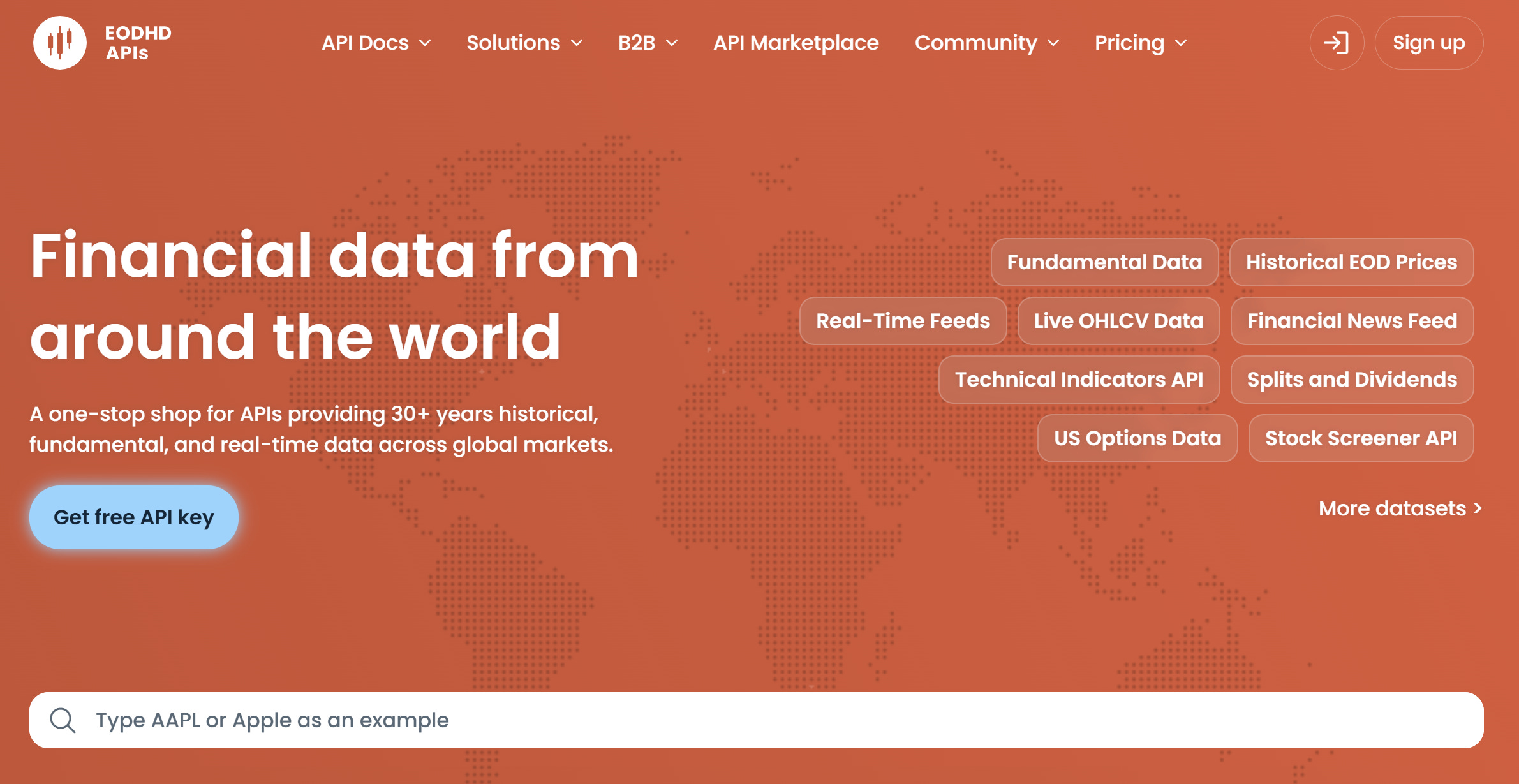
EOD Historical Data, now commonly presented as EODHD, offers a broad financial data platform spanning fundamentals, historical end-of-day prices, live and real-time feeds, intraday data, U.S. options, financial news, stock screeners, technical indicators, and exchange/reference datasets. On its homepage, the company positions itself as a “one-stop shop” for 30+ years of historical, fundamental, and real-time data across global markets, with coverage figures including 60 stock exchanges and 150,000 tickers.
One of EODHD’s strengths is that it sits between lightweight developer tools and more professional research infrastructure. It offers structured JSON and CSV responses, coding libraries, spreadsheet add-ons, and a broad menu of market datasets without being limited to only one narrow workflow. It also exposes precomputed technical indicators through API endpoints rather than requiring users to calculate everything from raw time series.
This combination makes EODHD particularly attractive for builders who want reasonably broad market-data coverage and analytics features in a format that remains accessible to smaller teams, solo developers, and applied AI prototypes.
What makes it valuable in the AI Agent era?
1. Official MCP support for agent integration
EODHD provides an official MCP server for financial data and explicitly documents how to connect it to ChatGPT, Claude, and custom AI agents. The company describes this as a way for AI agents and LLMs to access real-time and historical financial data directly through MCP, making EODHD one of the clearest AI-era data providers alongside Alpha Vantage and Tradier.
2. An official ChatGPT-oriented financial assistant
Beyond MCP, EODHD also offers an official Financial Assistant for ChatGPT, which it describes as an AI that can generate code for EODHD APIs and provide finance insights grounded in real data and news. That does not just signal marketing interest in AI; it suggests the company is actively shaping its product and developer experience around LLM-driven usage patterns.
3. Strong structured outputs plus higher-level analytics
EODHD’s AI relevance is also practical. It provides structured JSON/CSV outputs, extensive API documentation, libraries, and technical-indicator endpoints that already package financial signals into machine-usable form. For agentic systems, that reduces the burden of transforming raw market data before it can be used in screening, summarization, ranking, or recommendation workflows.
In short
EODHD is one of the strongest all-around options for the AI agent era. It combines broad market coverage with precomputed indicators, developer-friendly structured data, an official MCP server, and a ChatGPT-oriented assistant. For teams that want something more AI-forward than classic enterprise vendors but broader than a narrow single-purpose API, EODHD is a very strong choice.
QuoteMedia
Overview
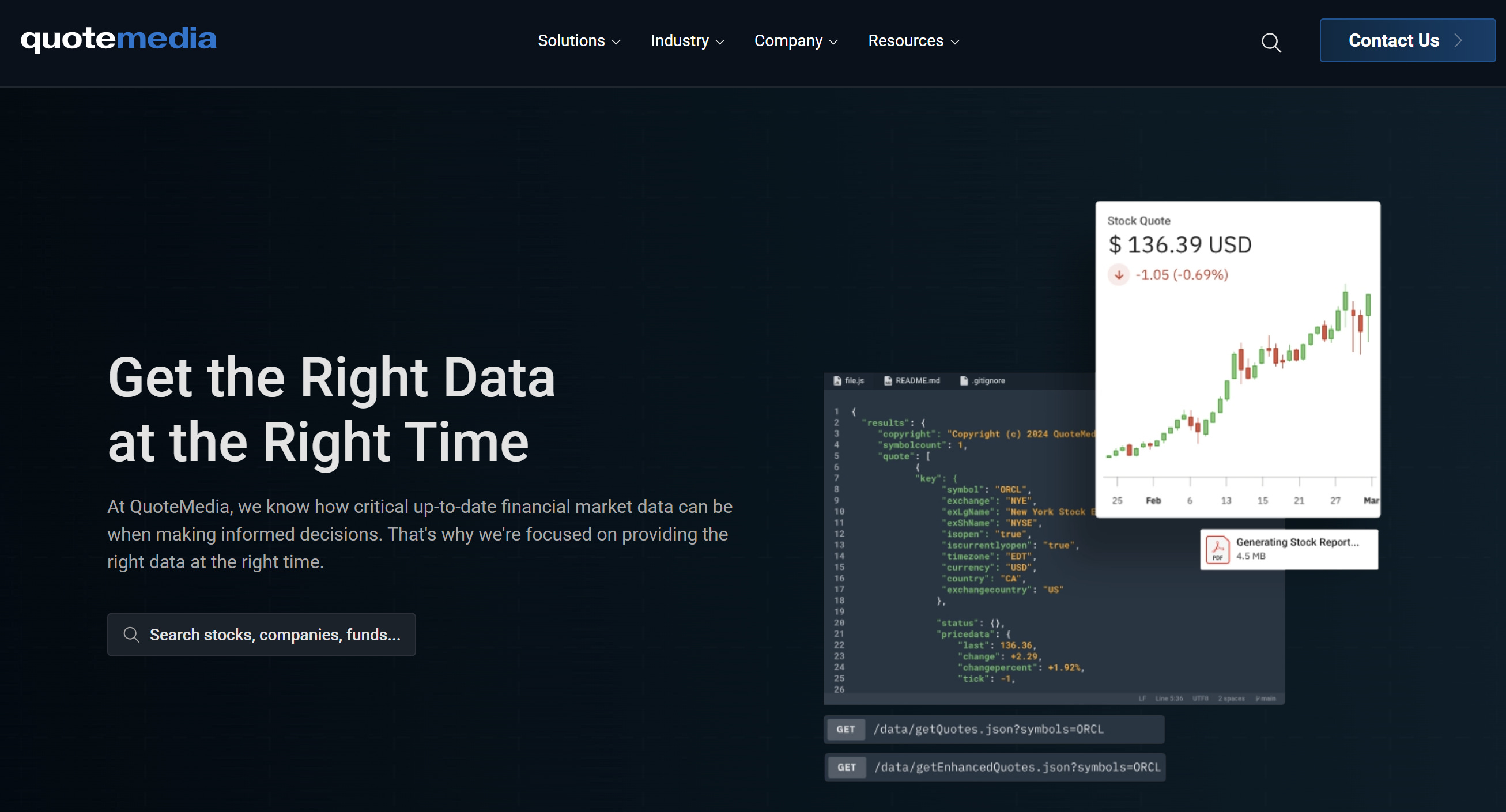
QuoteMedia is a long-standing market-data provider focused on real-time and historical data, news, analytics, and financial information for brokerages, websites, trading systems, and investor-facing products. Its Request APIs and OnDemand services are built around cloud-based access to market data, while its streaming products emphasize tick-by-tick delivery, low latency, and enterprise-grade reliability. QuoteMedia also highlights broad operational scale, including 110+ global exchanges, 200+ data APIs, 99.99% uptime, and 100+ news providers.
A notable strength of QuoteMedia is delivery flexibility. Its platform spans REST-style OnDemand APIs, WebSocket and other streaming interfaces, and SFTP-based file services for bulk delivery. It also supports JSON, XML, CSV, option-chain data, company profiles, historical time series, filings, and custom calculations. That makes QuoteMedia less of a single API product and more of a market-data delivery platform.
QuoteMedia’s public positioning is similar to Xignite in one important way: it is more infrastructure-oriented than explicitly LLM-oriented. In other words, its clearest strengths are reliability, breadth, delivery options, and integration into financial products, not public MCP or agent-marketing. That is an inference from the official materials reviewed.
What makes it valuable in the AI Agent era?
1. Low-latency data for real-time agent monitoring
QuoteMedia’s streaming stack is designed for real-time or delayed tick-by-tick data, normalized for ease of use and optimized for single-digit millisecond performance. For AI systems that monitor live markets, score signals, or trigger alerts and workflows off intraday movement, that kind of delivery profile is highly relevant.
2. Multiple delivery modes for different agent architectures
Modern AI finance stacks are not monolithic. Some components work best with REST requests, others with streams, and others with bulk files for offline training or evaluation. QuoteMedia supports cloud REST APIs, streaming APIs, and SFTP/file services, which makes it well suited to organizations building layered pipelines that combine real-time agent behavior with batch analytics and historical model development.
3. Strong fit as a production data layer
QuoteMedia offers market data, news, analytics, company profiles, option chains, filings, and historical data in structured formats such as JSON, XML, and CSV. That breadth makes it a useful foundation for internal copilots, research dashboards, summarization systems, and client-facing financial applications where the “AI” layer is built on top of the data platform rather than bundled by the vendor itself.
In short
QuoteMedia is a strong candidate for teams that care more about production-grade delivery and integration flexibility than about whether the vendor has already branded itself around AI agents. In the AI agent era, that still matters a lot: a reliable, low-latency, multi-format market-data backbone can be more valuable than flashy AI positioning if you are building your own orchestration layer.
Conclusion
If the goal is to find the most AI-ready providers, Alpha Vantage, Tradier, and EODHD stand out because they already offer MCP or LLM-oriented support. Alpha Vantage is particularly strong for AI-native research tools, Tradier is strong for brokerage-connected agents, and EODHD is a strong general-purpose choice.
If the goal is enterprise-grade infrastructure for proprietary AI systems, Xignite and QuoteMedia remain highly relevant. They may be less visibly AI-marketed, but they are strong as scalable market data backbones.
So in the AI agent era, the best stock market data API depends on what you are building. For AI-native financial research, Alpha Vantage has a strong edge. For execution-oriented agents, Tradier stands out. For broad AI-enabled workflows, EODHD is highly competitive. For enterprise infrastructure, Xignite and QuoteMedia are still important players.
such a nice overview of a very specific and important topic!