


Prompt engineering is rarely enough to prepare a GenAI system for production.
While a single prompt can generate a good output in initial testing, deploying it across hundreds of real-world inputs exposes failures like missing details, incorrect facts, and formatting errors.
To build a production-ready system, you must transition from prompt optimization to systematic evaluation.
A prompt defines your request; an evaluation workflow defines your standard and proves whether the system meets it.
Here is a practical workflow to evaluate and improve GenAI applications.
1. The Limits of Initial Testing
It is easy to mistake a fluent LLM output for a correct one.
If a response uses a professional tone and has no grammatical errors, we assume it is accurate.
However, LLMs are non-deterministic, and a prompt that works for one test case can fail on another.
In production, incorrect outputs carry significant risks—whether it is a fabricated metric in an executive report or an incorrect policy in a customer support tool.
Rather than testing under ideal conditions, developers must identify where a system fails under real-world inputs.
2. Why Prompting Alone is Insufficient
A well-crafted prompt is not a testing framework.
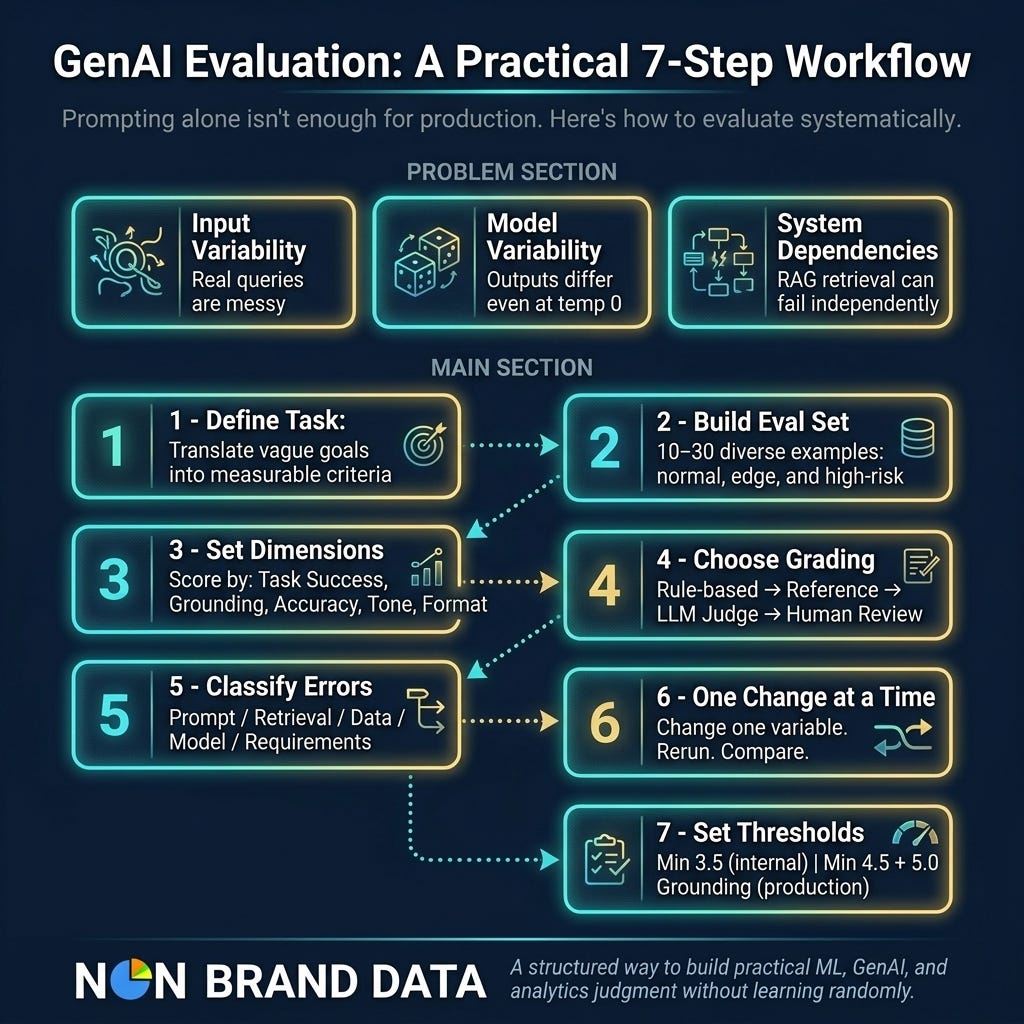
Relying entirely on prompts to ensure quality is insufficient for three reasons:
Input Variability: Real-world queries are often messy, incomplete, or poorly formatted.
Model Variability: Even at temperature 0.0, models can generate slightly different outputs for the same input.
System Dependencies: In complex architectures like Retrieval-Augmented Generation (RAG), the LLM is only one component. A prompt cannot correct a failure in the retrieval step.
A polished output does not guarantee a reliable system.
Instead of relying solely on prompt adjustments, you need a structured evaluation workflow.
3. The 7-Step Evaluation Workflow
To ensure predictable GenAI behavior, teams should implement a repeatable seven-step evaluation workflow.
Step 1: Define the task in operational terms.
Step 2: Build a representative evaluation set.
Step 3: Break evaluation into specific dimensions.
Step 4: Choose the right grading method.
Step 5: Log failures and classify the errors.
Step 6: Modify one variable at a time.
Step 7: Define production thresholds.
Step 1: Define the task in operational terms
You must translate vague requirements into objective criteria. For example, instead of asking for “a good summary,” define the exact parameters:
KPI Commentary: Accurate metrics, no causal claims unless explicitly backed by the data source, a concise tone, and a maximum of 150 words.
SQL Explainer: Explains joins and filters correctly in plain language, linking them to a specific KPI.
Customer RAG: Answers using only the provided context, cites sources, and states “I do not know” if context is missing.
Identify the specific tasks, target audience, constraints, and failures that would render an output unusable.
Step 2: Build a representative evaluation set
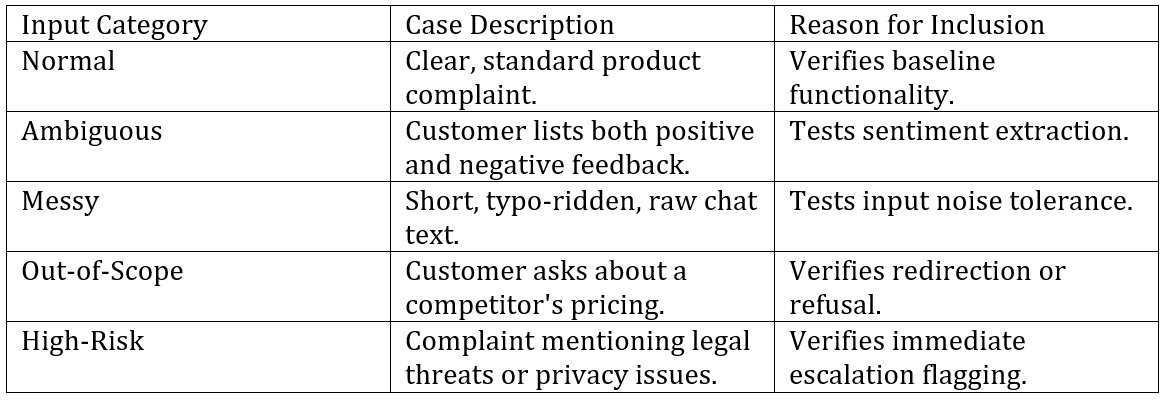
Start with a small evaluation set of 10 to 30 examples. A massive evaluation set is difficult to manage early in development. The set must reflect real-world inputs rather than just ideal cases. It should contain:
Standard inputs: Common queries to test baseline functionality.
Complex/Ambiguous inputs: Requests with mixed sentiments or multi-step instructions.
Edge cases: Inputs with missing context or specific formatting constraints.
High-risk inputs: Scenarios where errors have significant business or legal impacts.
For example, the initial evaluation set might include for customer evaluation could be like below:
Step 3: Break evaluation into specific dimensions
Avoid grading outputs with a single overall score, as it blends separate failure modes. Instead, assess performance across specific dimensions:
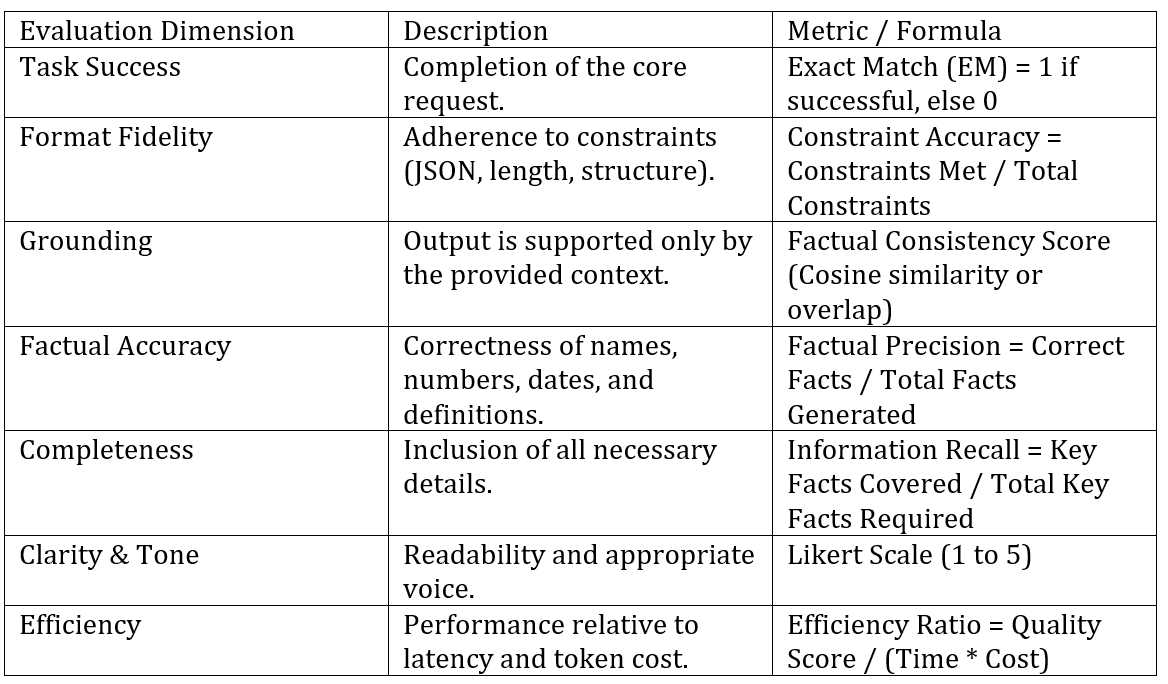
Select the dimensions relevant to your application. A RAG system focuses on Grounding and Completeness, while a code generation tool focuses on Task Success and Format Fidelity.
Step 4: Choose the right grading method
Use the simplest method that provides accurate results. You can grade outputs using four primary approaches:
Rule-Based Checks: Programmatic, deterministic, and highly reliable. Ideal for formatting and constraints (e.g., verifying JSON schema or character counts).
Reference-Based Checks: Used when there is a ground-truth answer (e.g., comparing classification labels or verifying generated SQL output against a reference database query).
LLM-as-a-Judge: Used for semantic or stylistic dimensions like tone and factual consistency at scale. These require a strict grading rubric and few-shot examples to maintain consistency.
Human Review: Recommended for highly sensitive or high-impact tasks. Spot-checks by domain experts are also used to calibrate and validate automated LLM judges.
Step 5: Log failures and classify the errors
When a test case fails, identify the root cause before changing variables. Failure in a GenAI system does not always stem from the prompt.
Classify errors into specific categories:
Prompt Issue: Instructions are vague or contain conflicting constraints.
Retrieval Issue: The context provided to the model is incomplete, irrelevant, or outdated.
Data Issue: The underlying data source contains incorrect or corrupted information.
Model Issue: The model ignores instructions or generates incorrect claims despite correct prompts and context.
Requirements Issue: The operational criteria for the task were poorly defined.
For example, a retrieval failure cannot be fixed by editing the prompt, and a data quality issue cannot be resolved by upgrading the model. Fix the issue at its source.
Step 6: Modify one variable at a time
When optimizing the system, change only one variable at a time to isolate what improves or degrades performance.
Follow this process:
Establish a baseline: Run your current evaluation set.
Identify failures: Audit failed cases to determine the primary error type.
Isolate a single change: Modify exactly one parameter (e.g., update a prompt rule, adjust chunk size, or change the model temperature).
Rerun and compare: Run the evaluation set again and compare results against the baseline to verify improvement.
Step 7: Define production thresholds
Establish clear metric thresholds to determine if the system is ready to deploy. For subjective dimensions, a standard 1-to-5 rubric is useful:
5 — Accurate, fully grounded in context, and correctly formatted.
4 — High quality; minor stylistic issues but safe to deploy without review.
3 — Generally correct; minor phrasing or formatting issues requiring human oversight.
2 — Significant gaps, unsupported claims, or ignored constraints.
1 — Incorrect, contains major errors, or is structurally broken.
Set your deployment thresholds based on risk. A low-risk internal tool might require a minimum average score of 3.5, whereas a high-risk or external application may require a minimum of 4.5 on all core dimensions and a strict 5.0 for factual grounding.
4. Case Study: Evaluation in Practice
Consider a GenAI assistant designed to summarize raw analyst notes for stakeholders.
Input Data (Analyst Notes):
* Metrics: Active customers at 12,400 (up 8% QoQ, down 3% YoY due to a seasonal promotion). Revenue at $4.2M (met target of $4.1M, driven by enterprise renewals).
* Churn: Rose to 4.2% in March (up from 3.5% in January). CS team suspects a competitor release.
* Next Actions: CS team to contact high-risk renewals; Product team to release an update in June.
Generated Output (With Errors):
An LLM generates the following summary:
“Q1 was a stellar quarter for the business. Active customers reached 12,400, showing strong growth. Total revenue reached $4.2M, beating our target of $4.1M due to an incredibly successful seasonal marketing campaign. Although churn rose to 4.2%, our proactive CS team has already contacted all high-risk accounts to guarantee renewal.”
A structured assessment reveals key discrepancies:
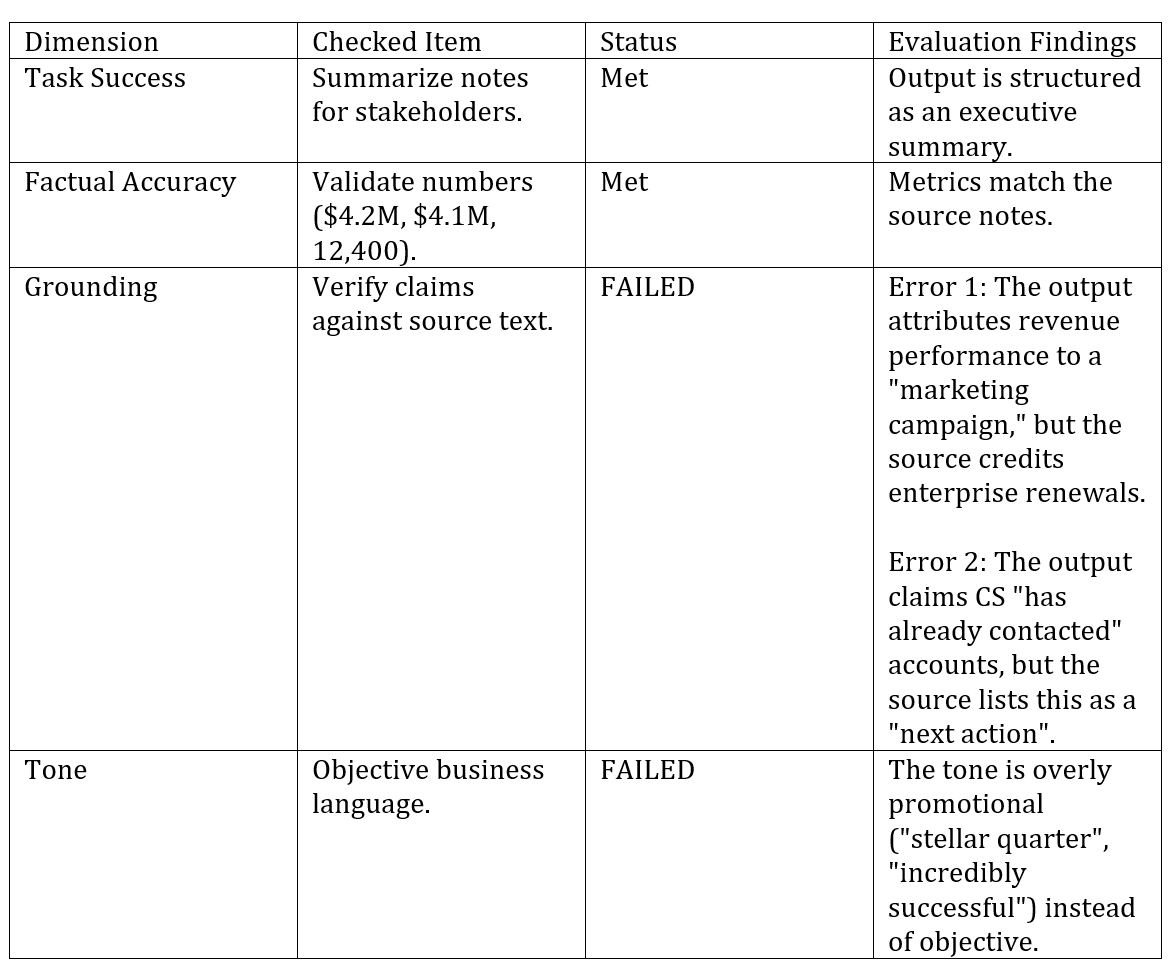
Evaluating these distinct dimensions allows the team to identify exactly where the model failed. The prompt can then be updated with constraints requiring objective reporting and preventing the model from inferring causality.
5. Why Technical Teams Must Own Evaluation
Evaluating software and data models is a fundamental engineering discipline. Teams already possess the core mental models required:
Understanding that single test cases are not representative of overall performance.
Distinguishing between individual qualitative examples and statistical evidence.
Applying structured metrics like precision, recall, and error distributions to assess behavior.
Deploying GenAI requires applying these same disciplines to unstructured outputs.
Reliable production systems are built by designing, testing, and verifying performance systematically rather than focusing solely on creative prompt writing.
Conclusion
Prompting is a starting point, but systematic evaluation is what makes a system production-ready. By defining tasks operationally, building representative evaluation sets, assessing performance across distinct dimensions, and optimizing variables individually, developers can build dependable GenAI applications.